



A hair transplant is one of the most permanent decisions you will ever make about your appearance. Choosing the right hair transplant doctor is not just important; it is arguably the single most consequential decision in the entire process.
I’ve been performing hair restoration surgery exclusively since 1990. In over 35 years, I’ve completed more than 15,000 procedures and spent a significant portion of my time repairing work done poorly by other surgeons.
In fact, roughly 40% of the patients I treat at Forhair come to me because a previous procedure went wrong. That number still stops me cold. It doesn’t have to be that way, but it will keep happening as long as patients choose a surgeon based on price or convenience alone.
This guide is my honest breakdown of how to find the best hair transplant doctors, what questions to ask, what red flags to walk away from, and how to verify everything independently.
Why Your Choice of Hair Transplant Specialist Matters
According to the International Society of Hair Restoration Surgery (ISHRS), more than 600,000 hair restoration procedures are performed each year globally, with the United States representing one of the largest markets.1
That volume brings with it an enormous range of skill levels — from pioneering specialists who have dedicated their entire careers to this one field, to general cosmetic practitioners who add hair transplants to a menu that also includes Botox and liposuction. The difference in outcomes is not subtle. A poorly executed transplant can result in an unnatural hairline, visible scarring, patchy density, or permanent donor damage that limits your options for repair. These are not rare complications; they are predictable consequences of choosing the wrong surgeon.
Repair procedures, when they are even possible, are estimated to cost between $10,000 and $50,000 or more, and the results may never be as good as getting it right the first time.
The standard you should hold any hair transplant specialist to is simple: can they show you documented, long-term results for patients with a similar degree of hair loss to yours? If not, move on.
Non-Negotiable Medical Credentials: How to Verify Any Surgeon
Credentials are a starting point, not a finishing line. They tell you a surgeon has met a baseline of knowledge — they do not guarantee skill. Use them to filter your shortlist, then apply the deeper tests below.
Active Medical License
Every US state has a medical board that publishes license status, disciplinary history, and malpractice records online. This takes five minutes and costs nothing. Search the surgeon’s name before your consultation, not after.
Exclusive Practice
Ask directly: Is hair restoration the only thing this surgeon does? I have not performed any other procedure since 1990.
A surgeon splitting time between hair transplants, rhinoplasty, and body contouring will see a fraction of the case volume of a dedicated specialist. Volume translates into pattern recognition, complication management, and refinement of technique.
Credential Verification Checklist
- Active medical license confirmed on the state medical board website
- No disciplinary actions or unresolved malpractice claims
- Exclusively performs hair restoration
- At least 10 years of dedicated experience
- Published peer-reviewed research or presented at scientific conferences

Finding the Right Hair Transplant Doctor – Going Beyond the Basics
Finding a hair transplant surgeon who balances skill with ethics is vital, but it’s often difficult because patients tend to keep their results private. To help you navigate the process, here is a breakdown of how to evaluate a doctor’s credibility and why I stand out in the field.
1. Look Beyond Memberships
While professional organizations are a good starting point for verifying a doctor’s background, they do not automatically guarantee high-quality surgical results. Key organizations include:
- Certification Boards: ABHRS (American Board of Hair Restoration Surgery) and IBHRS (International Board).
- Professional Societies: ISHRS, FUE Europe, IMCAS, and the Asian Association of Hair Restoration Surgeons.
- Consumer Alliances: The IAHRS (International Alliance of Hair Restoration Surgeons).
Memberships in societies and board certification reflect knowledge and authority, but they do not reflect a highly skilled surgeon. Membership in the IAHRS similarly does not ensure a skilled surgeon, because this organization does not visit clinics or evaluate patients in person. Furthermore, one must pay to become a member of the IAHRS. Ultimately, it is up to the patient to evaluate the surgeon’s skills and expertise.
2. Evaluate Authority and Expertise
A surgeon’s reputation is built on a combination of peer recognition and physical evidence.
Why I Consider Myself One of the Best Hair Transplant Doctors in the USA — And How to Hold Me to That Standard
I include this section not to self-promote, but because I believe in transparency. If you are going to trust any surgeon with a permanent procedure, you should be able to verify every claim they make.
My credentials highlight my position as a pioneer in the industry:
- Early Leadership: One of the first 30 diplomats of the ABHRS; I later served on its Board of Directors and examination committee.
- Global Influence: I have organized major meetings for the ISHRS and every FUE Europe meeting between 2017 and 2023.
- Educational Impact: I serve on the Board of Directors for the IMCAS World meeting and was the 2025 keynote speaker for IMCAS Americas in Brazil.
- Pioneer of modern FUE: I began developing and refining FUE techniques in 2003, before the method was widely adopted. Surgeons around the world now use instruments and techniques I developed. Learn about our technology here.
- 35 years of exclusive practice: I have performed no other procedure since 1990. Every case I’ve done has been hair restoration.
- 15,000+ procedures completed: With documented before-and-after results available for review. See our patient gallery.
- Patient reviews: Read what patients say in their own words at our patient reviews page or on independent platforms, including RealSelf and Google.
Apply every standard in this article to me. If I can’t meet it, you should find someone who can.
3. The Final Proof: Results
While board certifications and speeches prove authority, they don’t always prove artistry. To truly judge a surgeon’s expertise, you must look at their work. I back my academic credentials with one of the most extensive and impressive patient result galleries in the industry. The Bottom Line: Use credentials to narrow your search, but use a surgeon’s proven results to make your final decision.
FUE vs FUT: What Technique Expertise Should You Look For?
The two primary hair transplant techniques differ significantly in how grafts are harvested. Understanding the distinction helps you ask better questions during a consultation.
I pioneered modern FUE in 2003 and subsequently developed CIT® (Cole Isolation Technique), which uses a minimal-depth approach to graft extraction that preserves the stem cell region of each follicle.
For patients who prefer no shaving requirement, we also offer No-Shave FUE (C2G), which allows a completely discreet procedure with no visible evidence of surgery. You can read a detailed comparison of FUT vs FUE here.
When evaluating any surgeon’s technique expertise, ask specifically:
- How many FUE procedures have you personally completed?
- When did you start performing FUE?
- What punch size do you use, and why?
Smaller punches (0.8–0.9mm) cause less scarring and require greater precision. Larger punches are easier to use but generally more damaging to the donor area.
The 15 Questions to Ask Before You Commit
I tell every prospective patient: grill me. Ask hard questions. A surgeon who gets defensive or vague during a consultation will be no different when things go wrong during or after surgery.
About credentials and experience:
- Where did you obtain your medical degree, and when did you graduate?
- In which states are you licensed to practice?
- Are you board-certified by the ABHRS or IBHRS?
- How long have you been performing hair restoration surgery exclusively?
- How many procedures have you performed overall, and how many using the specific technique I’m considering?
About the procedure:
- How many grafts do I realistically need? (Be wary of inflated numbers — more grafts mean a higher bill)
- What density can I realistically expect after one session?
- Can you show me the instrument you use under magnification, and explain your punch size?
- Will you personally perform every aspect of my procedure? (Technician-performed surgery is illegal in most US states)
- How do you handle shock loss post-procedure?
About results:
- Can I see 50+ before-and-after photos with documented graft counts, Norwood stage, and timeline?
- Can you provide references — former patients I can contact directly?
- Can you show me results from patients with similar hair texture, color, and degree of loss to mine?
About complications:
- What is your infection rate? (It should be under 1%, ideally near zero)
- How do you handle cases where graft survival is poor? What is your policy on touch-ups?
Red Flags: Warning Signs of a Bad Hair Transplant Doctor
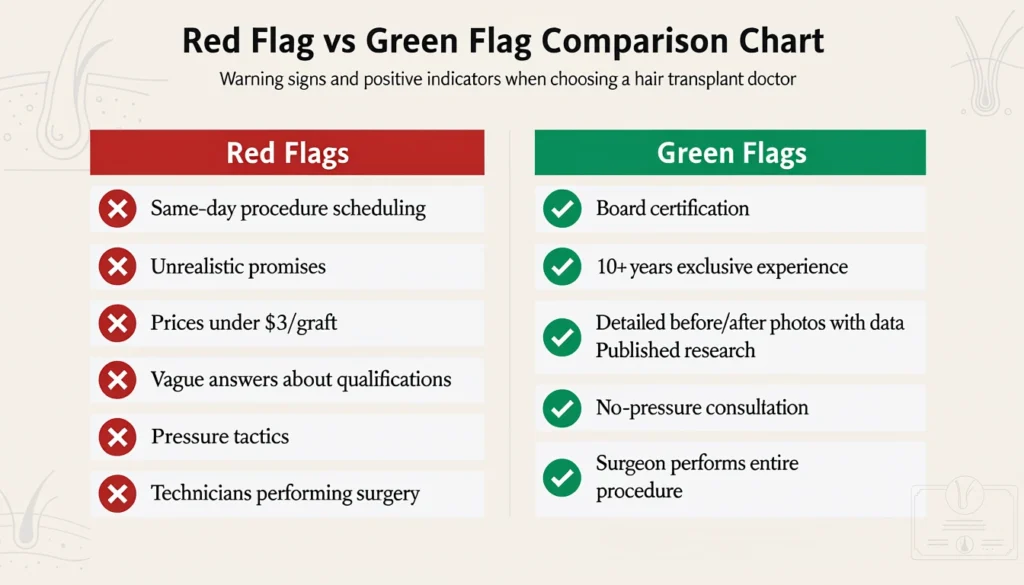
After 35 years, I know exactly what separates a skilled surgeon from a dangerous one. The following are non-negotiable deal-breakers.
Pressure Tactics
A rushed consultation under 20 minutes, same-day procedure scheduling, or “limited time” pricing discounts are all signs that a clinic is prioritizing volume over patient outcomes. Walk away immediately.
Unrealistic Promises
No surgeon can guarantee full density in a single session. Native density in a healthy scalp is 70–100 follicular units per cm² — that is not achievable through transplantation alone. Any surgeon claiming otherwise is not telling you the truth.
Suspiciously Low Pricing
FUE procedures priced below $5 per graft in the USA in 2026 warrant serious scrutiny. Cost reductions come from somewhere: untrained technicians, rushed timelines, or compromised sterile conditions. We will cover pricing in detail in the next section.
Very Few Before-and-After Photos
Legitimate hair transplant surgeons accumulate hundreds of documented cases over their careers. A handful of cherry-picked photos is not evidence of consistent quality.
Technicians Performing Surgery
Some clinics have unlicensed technicians perform graft extraction or placement while the surgeon supervises, or is absent entirely.
This is illegal in most US states and is one of the most common causes of poor results and complications. Ask directly: “Will you personally perform every surgical step?” If the answer is evasive, find another surgeon.
No Mention of Future Hair Loss Planning
Hair loss is progressive. A good surgeon plans not just for today’s transplant but for what your hairline will look like in 10 and 20 years as native hair continues to thin. Conservative, long-term planning is a sign of integrity. Aggressive placement that ignores future loss is a sign of greed. Thinking about a second opinion on a surgeon you’re already evaluating? Dr. Cole offers second-opinion consultations for patients comparing clinics or reviewing previous work.

Cost vs Value: What Does the Best Hair Transplant in the USA Actually Cost?
The honest answer: quality hair transplants in the United States are not cheap. That is a feature, not a bug.
Average legitimate FUE costs in the USA (2025–2026):
- Per graft: $5–$12
- Typical procedure (1,500–3,000 grafts): $7,500–$36,000
- Large sessions (3,000+ grafts): $30,000+
These prices are estimates; they can vary between regions and practitioners.
What you are paying for is the surgeon’s time, trained staff, sterile surgical facilities, high-quality instruments, post-operative care, and emergency availability. Cutting costs means cutting corners somewhere in that chain.
The long-term maths are unambiguous. A cheap procedure that requires repair costs anywhere from $10,000 to $50,000+ to correct, assuming correction is even possible.
Permanent donor damage from aggressive or careless extraction cannot be undone. I have seen patients arrive at ForHair having spent $3,000 on a procedure abroad, then spend $25,000 trying to fix what was done. The initial “saving” evaporated and then some.
You can get an accurate estimate for your specific case using our hair transplant graft calculator, or review our transparent pricing page for a full breakdown.
Specific Questions to Ask During Consultation
I tell prospective patients: grill me. Ask hard questions. If I can’t answer, you shouldn’t let me operate.
About the Procedure
Q: “How many grafts do I realistically need?”
A: Beware of inflated numbers. More grafts = higher bill. Conservative estimates indicate honesty.
Q: “What’s my expected density after one procedure?”
A: Can’t achieve native density (70-100 follicular units per cm²) in one session. Anyone claiming otherwise is lying.
Q: Will you show me your instrument under magnification?
A: Punch size matters in FUE. Smaller punches (0.8-0.9mm) cause less scarring. Larger punches are easier for inexperienced surgeons but more damaging.
About Results and Expectations
Q: “What percentage of your patients need a second procedure?”
A: Honest answer: Many. Depends on the extent of loss and goals.
Q: “How do you handle shock loss?”
A: Temporary shedding after transplant. Normal, but needs experienced management. What’s their protocol?
Q: “Can I see results from patients with similar hair characteristics?”
A: Hair texture, color, and skin tone affect results. See outcomes matching your features.
About Complications
Q: “What’s your infection rate?”
A: Should be under 1%, preferably near zero.
Q: “How do you handle poor graft survival?”
A: Sometimes grafts don’t take. What’s their policy on touch-ups or communication when it happens?
Q: Have you been sued for malpractice related to hair transplants?”
A: Legitimate question. Check the state medical board records to verify the answer.
Comparing Doctors: Objective Criteria
How do you actually compare surgeons? Use data, not marketing.
Outcome Metrics to Request
Graft Survival Rate
Industry standard: 90-95% survival. Some claim higher. Ask for documentation, not anecdotes.
My CIT® technique: 97%+ graft yield due to minimal trauma during extraction.
Before/After Photos with Specifications
Photos should include:
Patient Testimonials (Verified)
Google Reviews, RealSelf, and Facebook show verified patient experiences.
Check multiple platforms and, most importantly, ask to talk to real patients and referrals.
Geographic Considerations (When They Matter)
You asked about the location. Here’s when it matters and when it doesn’t.
When Location Doesn’t Matter
For straightforward FUE cases. Healthy donors. Predictable results. Travel to the best surgeon, even if across the country.
80% of my patients travel to Atlanta from elsewhere. Worth it for quality results you’ll live with forever.
When Local Matters
Repairs or complex cases require multiple sessions. Post-op complications need in-person evaluation. Convenient follow-ups are important.
Even then, many patients choose quality over convenience.
Hidden Costs of Cheap Procedures
Poor results requiring repair: $10,000-50,000+. Scarring requiring body hair transplant: Additional $15,000-30,000. Permanent damage: Priceless (in the bad way).
Repairs cost more than doing it right initially. I repair 40% of my patients‘ previous bad work from other clinics.
Frequently Asked Questions
How do I find the best hair transplant doctor in the USA?
Ask for patient references. Legitimate surgeons provide contacts. Call those patients. Ask about their experience, results, and any complications.
Check state medical board for license verification and any disciplinary actions. Search RealSelf and Google Reviews for unfiltered patient feedback.
Request to see at least 50-100 before/after photos with complete data (graft counts, timelines, patient characteristics). Few photos indicate limited experience or cherry-picking.
What if the cheapest option has good reviews?
Investigate thoroughly. Some budget clinics maintain quality through volume efficiency. Others cut corners dangerously.
Ask: Who performs the actual surgery? Physician or technicians? What’s their infection rate? How many procedures do they perform daily? (More than 2-3 per day raises quality concerns.)
Read negative reviews carefully. Patterns emerge. One bad review might be an outlier. Ten similar complaints indicate systemic problems.
Should I choose a doctor who invented their own technique?
Investigate thoroughly. Some budget clinics maintain quality through volume efficiency. Others cut corners dangerously.
Innovation indicates deep expertise. But “proprietary technique” sometimes just means clever marketing.
Ask what makes their technique different. Request published research supporting superiority claims. Check if other reputable surgeons use similar methods.
I developed CIT® in 2003. Widely adopted by other surgeons globally. Published research demonstrates advantages. That’s legitimate innovation.
“Dr. Smith’s Revolutionary Hair Miracle Method™” with zero independent validation? Skepticism warranted.
How important is the consultation experience?
Very. Reveals the surgeon’s communication style, honesty, and pressure tactics.
Good consultation: 30-60 minutes. Detailed scalp examination. Realistic outcome discussion. Answers all questions thoroughly. No pressure to decide immediately.
Bad consultation: 15 minutes. Generic advice. Inflated promises. Immediate scheduling pressure. Dodges questions about complications or limitations.
Trust your instincts. If something feels off, it probably is.
What if I can’t afford the best surgeon?
Wait and save. Seriously.
Bad hair transplant costs more to repair than doing it right initially. Plus years of looking worse than before starting.
Some surgeons offer financing. CareCredit and medical loans available. Saving $500/month for 12-18 months makes a quality procedure affordable. Don’t finance a cheap procedure. Don’t put a bad hair transplant on a credit card.
Dr. Cole’s Final Recommendations
I’ve trained hundreds of surgeons. Performed over 15,000 procedures. Repaired thousands of botched surgeries from other clinics.
Here’s what I tell every prospective patient:
The Bottom Line
A hair transplant done well is genuinely life-changing. A hair transplant done poorly can be devastating — financially, aesthetically, and emotionally. The difference almost always comes down to the surgeon you choose.
Do your homework. Verify credentials independently. Ask hard questions. Look at a large volume of documented results. And don’t let cost or convenience be the deciding factor in a decision you’ll live with for the rest of your life.If you’d like to speak directly with one of the most experienced hair transplant specialists in the USA, your first consultation with Forhair is completely free — available virtually or in person at our Atlanta and New York clinics.
Sources:
1. International Society of Hair Restoration Surgery: 2022 Practice Census Results. 2022.
2. Gupta AK, Love RP, Harris JA. Old Friend or New Ally: A Comparison of Follicular Unit Transplantation and Follicular Unit Excision Methods in Hair Transplantation. Dermatol Surg. 2020 Aug;46(8):1078-1083. doi: 10.1097/DSS.0000000000002373. PMID: 32141930.
3. “FUT vs FUE Hair Transplant Method – Which One Is Better? Forhair.” ForHair Hair Transplant Clinic, 22 Dec. 2022, www.forhair.com/fut-vs-fue-method/. Accessed 19 Mar. 2026.